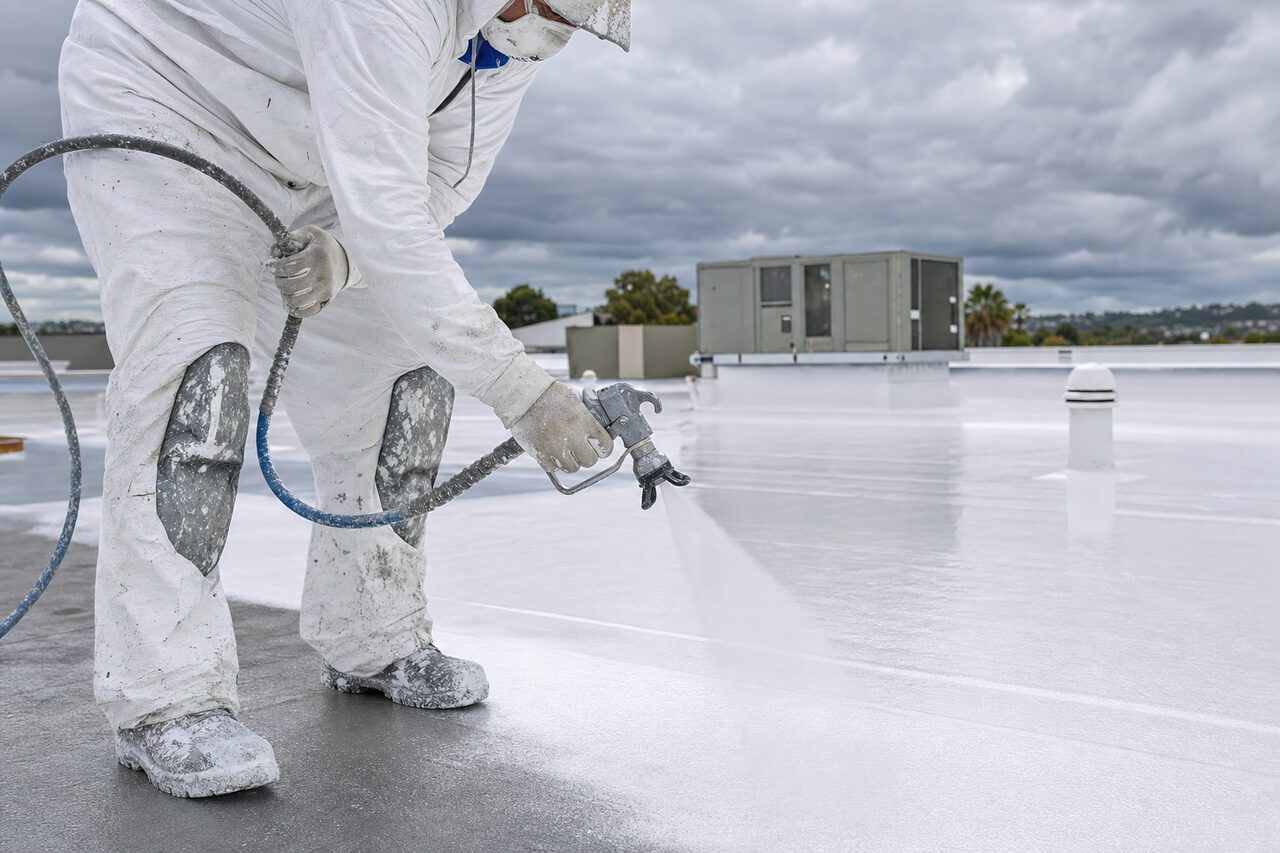
How long does a silicone roof coating last?
Some silicone restoration systems can add up to 20 years of useful roof life, but actual performance depends on the existing roof, specified coating thickness, application quality and maintenance, so the selected system’s written requirements and inspections matter more than a universal lifespan claim.
Sources: GAF High Solids Silicone system overview
Can you apply roof coating over a leaking roof?
A leaking roof may qualify for restoration after the leak sources are located and repaired, wet or damaged materials are addressed, and the remaining assembly passes moisture and adhesion checks, because applying a finish coating over active leaks or trapped moisture can leave the underlying problem unresolved.
Sources: GAF High Solids Silicone data sheet
What is the best temperature to apply an acrylic roof coating?
Choose dry weather within the selected acrylic’s application limits; 50°F and rising is a common minimum rather than an ideal temperature, and some systems require a 24–48-hour rain-free window, so confirm the product’s air and surface temperatures, moisture restrictions and curing forecast before scheduling.
Sources: GAF Acrylic Top Coat data sheet · KARNAK 501 application guidance · Western Colloid 720 data sheet
01Pricing, Costs, and Financial ROI
What is the average cost per square foot for a commercial silicone roof coating?
Commercial silicone roof coating is quote-dependent because roof condition, removal of wet materials, preparation, seam and flashing repairs, specified thickness, access, and labor change the installed price; request a measured, itemized scope to establish a dependable cost per square foot.
Sources: Progressive Materials: How to Estimate Roof Coating Restoration Projects · GAF: Roof Coating vs. Commercial Replacement: A Guide for Commercial Buildings
How much does a commercial spray polyurethane foam (SPF) roof cost compared to TPO?
SPF and TPO need quotes for equivalent roof areas and performance requirements: include removal, insulation, attachment, flashing, access, and warranty, with SPF priced as foam plus its protective covering and TPO priced as a membrane assembly with any required insulation.
Sources: Spray Polyurethane Foam Alliance: SPF Roofing Installation and Maintenance · GAF: TPO Roofing Membranes
Is a roof coating system tax-deductible as a maintenance expense in the first year?
A roof coating may qualify as a current repair or maintenance deduction, but capital improvements follow different rules and eligible nonresidential roof improvements may qualify for Section 179; have a tax adviser classify the actual scope, ownership, business use and tax-year limits before budgeting a benefit.
Sources: Internal Revenue Service: Tangible property final regulations · Internal Revenue Service: Publication 946 (2025), How To Depreciate Property
How much can a cool roof silicone coating save on monthly commercial energy bills?
Monthly savings depend on climate, insulation, HVAC, roof reflectance, operating hours and utility rates; model net annual heating and cooling costs for the building before assigning a monthly saving, since winter heating effects can offset cooling gains and a lower roof-surface temperature does not establish a bill reduction.
Sources: U.S. Department of Energy: Guidelines for Selecting Cool Roofs
What is the cost difference between acrylic and silicone roof coatings?
Acrylic often has a lower upfront material price, while silicone can require a different system build-up; compare the appropriate primer, application rates, coats, detailing, labor and maintenance in both quotes because the per-gallon price difference does not determine the finished project cost.
Sources: Progressive Materials: Silicone vs. acrylic roof coatings: Which is best? · Progressive Materials: Acrylic or Silicone Roof Coatings?
Does a roof coating warranty cover both labor and materials (NDL warranty)?
Some NDL guarantees include labor and materials for covered leak repairs, while other coating warranties cover materials only; NDL means no dollar limit on covered repairs, so review the actual exclusions, registration, maintenance and installer requirements before assuming coverage or treating the warranty term as predicted roof life.
Sources: GAF: Liquid-Applied Diamond Pledge NDL Roof Guarantee specimen · Gaco / Amrize: GacoFlex Coating Pro-Rata Limited Material Warranty specimen
How much does it cost to coat a residential standing seam metal roof?
A residential standing-seam roof needs an individual quote based on measured area, slope and safe access, the existing factory finish, adhesion results, corrosion, seam repairs, and the compatible coating system, with any existing metal-roof warranty reviewed before work is selected.
Sources: Gaco: GacoFlex U91 and U92 for Restoring Aged Metal Roofing Systems · Progressive Materials: How to Estimate Roof Coating Restoration Projects
What is the cost of repairing a damaged or punctured spray foam roof?
SPF puncture-repair pricing depends on the damaged area, moisture findings, access, and whether the job needs localized filling or removal and replacement of compromised foam plus a protective coating; have an SPF roofing specialist define the repair extent before using a price allowance.
Sources: Gaco: GacoFlex U91 and U92 Re-Coat Specification · Gaco: Foam Repair Detail GA-RS-G-6 · Spray Polyurethane Foam Alliance: SPF Roofing Installation and Maintenance
Are there local energy efficiency rebates or PACE financing options for roof coatings?
MinnPACE may finance eligible Minnesota improvements, and utilities serving Minnesota or South Dakota may offer custom efficiency incentives, but coating eligibility depends on the property, utility territory, energy evidence and program approval; confirm requirements before ordering work and treat PACE as repayable financing.
Sources: MinnPACE / Saint Paul Port Authority: Eligibility Checklist · Saint Paul Port Authority: MinnPACE · Otter Tail Power Company: Custom efficiency grants · Xcel Energy: Savings — Business Services — South Dakota
How much value does a fluid-applied roof restoration add to a commercial property appraisal?
A fluid-applied restoration has no fixed appraisal uplift; its contribution depends on documented condition, market comparisons, operating costs and who receives any energy savings under the leases, so provide the appraiser with the scope, completion records, warranty and supportable performance data.
Sources: Appraisal Institute: Commercial Green and Energy Efficient Addendum, AI-821.02
Back to FAQ topics
02Material Selection: Silicone, Acrylic, Urethane, and Foam
What is the best roof coating for flat roofs with severe ponding water?
Silicone specified for ponding-water exposure is often a strong candidate for a serviceable flat roof, but severe ponding still calls for a drainage and structural assessment because a water-resistant coating cannot correct roof slope, blocked drains, or damaged decking.
Sources: GacoFlex S42 product and specification index · Gaco SP-S42-34-20 single-ply specification
What are the pros and cons of acrylic roof coatings versus silicone?
Acrylic coatings offer reflective, water-based protection for well-drained roofs, while selected silicone systems tolerate persistent ponding; acrylic needs suitable drying weather, and silicone requires attention to traction and compatible future repairs, with product instructions deciding the final choice.
Sources: GacoFlex A48 High Build Acrylic Roof Coating PDS · GacoFlex S42 product and specification index · GacoRoof product FAQs · GacoFlex U92 Aliphatic Urethane Topcoat PDS
When should you use a polyurethane roof coating instead of silicone?
Consider a specified polyurethane system when abrasion resistance and regular rooftop maintenance traffic drive the design, while checking whether an aromatic base coat needs an aliphatic or other approved topcoat for weather protection and whether existing silicone makes that system unsuitable.
Sources: GacoFlex U91 Aromatic Urethane product · GacoFlex U91 Single-Component Moisture-Cure Polyurethane PDS · GacoFlex U92 Aliphatic Urethane Topcoat PDS
What is the difference between open-cell and closed-cell spray foam for roofing?
Roofing SPF uses rigid, roof-grade closed-cell foam beneath a protective exterior covering, whereas open-cell foam commonly used inside attics is an insulation product rather than an exposed roofing system; specify the complete exterior roof assembly instead of substituting interior foam.
Sources: SPFA commercial applications · SPFA frequently asked questions · GacoRoofFoam F2733RHFO spray-applied polyurethane foam PDS
Can you use an elastomeric coating on a residential corrugated metal roof?
Yes, a compatible elastomeric system may be used on a residential corrugated metal roof after the metal and existing finish are identified, corrosion, loose fasteners, and seams are addressed, and the manufacturer’s adhesion, primer, slope, and application requirements are confirmed.
Sources: GAF liquid-applied roofing manual · Henry Pro-Grade 988 Silicone Roof Coating TDS
What type of roof coating holds up best against heavy hail and foot traffic?
No coating chemistry is universally best for heavy hail; compare tested roof assemblies and manufacturer impact ratings, then consider a polyurethane system for abrasion resistance and specify compatible walkways where maintenance traffic is expected.
Sources: SPFA frequently asked questions · GacoFlex U91 Aromatic Urethane product · Gaco SP-S42-34-20 single-ply specification
Is a solvent-based coating better than a water-based coating for low-slope roofs?
Solvent-based does not automatically mean better: evaluate adhesion, standing-water exposure, cure weather, fumes, ventilation, and membrane compatibility, since water-based acrylics, solvent-based urethanes, and solvent-free silicones have product-specific strengths and restrictions that affect an occupied building’s work plan.
Sources: GAF liquid-applied roofing manual · GacoFlex A48 High Build Acrylic Roof Coating PDS · Gaco SP-U91U92-43-20 single-ply specification · Henry Pro-Grade 988 Silicone Roof Coating TDS
What are the benefits of a high-solids silicone roof coating system?
High-solids silicone leaves more cured coating volume from each wet gallon than a lower-solids formula, and products such as Gaco S42 resist UV and ponding water, but final protection still depends on a sound roof, tested adhesion, repaired details, and specified dry-film thickness.
Sources: GacoFlex S42 product and specification index · Gaco SP-S42-18-10 single-ply specification
Can you apply a fluid-applied membrane over an old asphalt built-up roof (BUR)?
Yes, a compatible fluid-applied system can restore a sound, dry asphalt BUR roof after leaks and damaged materials are repaired, but gravel-covered BUR requires a separate approved preparation strategy, and the chosen silicone system may require an asphalt bleed blocker.
Sources: GAF silicone restoration over asphaltic roofs · GacoBase U95 product and gravel-encapsulation guidance · APOC 585 Armor Flex Liquid Silicone Roof Membrane technical data sheet
What brand of roof coating is best: GAF, Henry, Karnak, or APOC?
The best choice among GAF, Henry, Karnak, and APOC is the specific system that matches your roof membrane, drainage, verified adhesion, and written warranty requirements, so compare full preparation and coverage specifications rather than choosing by brand name alone.
Sources: GAF Limited Warranty on Liquid-Applied Roof Coatings COMCO155 · Henry Pro-Grade 988 Silicone Roof Coating TDS · Karnak 670HS Karna-Sil Ultra product guidance · APOC 585 Armor Flex Liquid Silicone Roof Membrane technical data sheet
Back to FAQ topics
03Substrate, Compatibility, and Inspection
Can you apply a spray-on silicone coating directly over a single-ply TPO roof?
Yes, silicone can be sprayed onto qualifying TPO, but direct application without primer is acceptable only when the selected manufacturer’s instructions and an on-roof adhesion test support it, after cleaning, drying, and repair of seams, flashings, and any wet areas.
Sources: Henry Pro-Grade 988 Silicone Roof Coating TDS · Gaco SP-S42-18-10 single-ply specification
What are the recommended spray-on coatings for GenFlex EPDM roofing systems?
An EPDM-approved silicone system may be suitable for GenFlex roofing after cleaning, repairs, moisture screening, and adhesion testing, but confirm the exact membrane, primer requirements, and any GenFlex warranty restrictions with both manufacturers before specifying or spraying it.
Sources: Henry Pro-Grade Silicone Roof Coating System Application Guide · GenFlex Roofing System Limited Warranty sample currently linked by GenFlex
Can you coat over a roof that already has a layer of failed or peeling coating?
A new coating should not be applied over peeling or detached material; remove failed coating, investigate the cause, repair the substrate, and test adhesion to any firmly bonded coating that remains before choosing a compatible restoration system.
Sources: Henry Pro-Grade Silicone Roof Coating System Application Guide · Gaco field adhesion-testing procedure
How do you test a commercial roof for trapped moisture before applying a coating?
A qualified roof evaluation combines visual inspection with a suitable moisture survey, such as infrared imaging or electrical impedance testing, then uses roof-core samples where needed to verify hidden conditions and define wet materials that must be removed before coating.
Sources: Henry Pro-Grade Silicone Roof Coating System Application Guide · GAF liquid-applied roofing manual
Can a spray foam roofing system be installed directly over gravel or ballasted roofs?
SPF should not be sprayed onto loose gravel or ballast; remove loose material, investigate moisture and roof attachment, and obtain a manufacturer-approved preparation or recover design so the foam bonds to a stable, dry substrate without compromising the roof assembly.
Sources: Gaco SPF-A48-33-15 roofing-system specification · Spray Polyurethane Foam Alliance: SPF Roofing Installation and Maintenance
What type of primer is required to apply a silicone coating over a weathered modified bitumen roof?
Use the asphalt bleed-blocking primer or base coat specified by the selected silicone manufacturer, such as Henry Pro-Grade 294 under Pro-Grade 988, with adhesion testing and any additional preparation required for the weathered modified-bitumen surface.
Sources: Henry Pro-Grade 988 Silicone Roof Coating TDS
Can you apply a protective coating over a modified bitumen cap sheet?
Yes, a compatible coating can protect a sound modified-bitumen cap sheet after loose granules, failed seams, wet materials, and other defects are addressed; identify whether the sheet is smooth or granulated, then follow the chosen manufacturer’s bleed-blocker, adhesion, and coverage instructions.
Sources: Karnak 670HS Karna-Sil Ultra product guidance · GAF silicone restoration over asphaltic roofs
How do you know if a commercial flat roof is too damaged for a coating restoration?
A roof may need replacement or substantial repair when inspection finds a damaged deck, widespread wet insulation, poor membrane attachment, exposed reinforcement, or brittle, shrinking material; a coating assessment must resolve those conditions before promising restoration of the remaining roof.
Sources: Gaco SP-S42-34-20 single-ply specification
Will a roof coating adhere properly to a PVC roofing membrane?
A compatible roof coating can adhere to sound PVC, but plasticizer loss, brittleness, shrinkage, surface contamination, and previous treatments can change suitability, so use a manufacturer-approved PVC system with cleaning, adhesion testing, and primer where required.
Sources: Gaco SP-S42-34-20 single-ply specification
What happens if you apply a roof coating over a wet or damp substrate?
Coating a wet or damp substrate can undermine adhesion and leave moisture beneath the new film, so wait for a properly dried surface, investigate moisture within the roof assembly, and remove wet materials before application, even when the chosen silicone is described as moisture-curing.
Sources: APOC 585 Armor Flex Liquid Silicone Roof Membrane technical data sheet · Henry Pro-Grade Silicone Roof Coating System Application Guide
Back to FAQ topics
04Surface Prep, Repairs, and Application Mechanics
How do you prepare a heavily rusted metal roof for an elastomeric coating?
A contractor should first determine whether corrosion has weakened panels or supports, replace unsound metal, remove loose rust and failed coating, clean and dry the roof, then use any specified rust-inhibiting primer and compatible seam repairs before proceeding with an adhesion-tested coating restoration.
Sources: GAF Unisil over metal specification · GAF metal roof primer
What PSI pressure washer is required to clean a commercial roof before coating?
There is no universal washer PSI: GAF’s coating manual specifies at least 2,000 psi, with 3,000 psi for certain substrates, but the contractor must reconcile those directions with the existing membrane’s cleaning limits and avoid damaging seams or forcing water beneath the roof.
Sources: GAF liquid-applied roofing manual · GAF EverGuard cleaning guidance
How do you treat and reinforce seams on a TPO roof before spraying a coating?
A qualified contractor should repair open TPO seams with compatible membrane materials, clean and dry the surface, verify adhesion, and install the coating system’s specified seam treatment, which can include reinforcing fabric embedded between compatible flashing coats before the roof receives its finish coating.
Sources: GAF liquid-applied roofing manual
What is the standard mil thickness required for a 10-year versus a 20-year silicone warranty?
No single mil standard applies: GAF’s Unisil-over-metal specification, for example, lists 23 dry mils for a 10-year system and 40 dry mils for a 20-year system, but eligibility depends on meeting the full manufacturer specification and applicable warranty requirements.
Sources: GAF Unisil over metal specification
How do you fix backed-out or loose fasteners on a metal roof prior to coating?
The contractor should tighten or replace backed-out fasteners, replace missing or deteriorated hardware, and confirm secure attachment before sealing the heads with the system’s compatible flashing product, because covering a loose fastener with coating does not restore its mechanical holding strength.
Sources: GAF Unisil over metal specification
What type of commercial airless spray equipment is required to pump high-solids silicone?
High-solids silicone needs an airless pump matched to coating viscosity, hose length and tip demand; Gaco’s silicone guide, for example, specifies a pump rated for at least 5,950 psi and commonly a 0.031-inch tip, with grounded, pressure-rated components and setup confirmed against the equipment manufacturer’s instructions.
Sources: Gaco silicone spray guide
How do you prevent overspray damage to nearby cars and buildings when spraying a roof?
Overspray control starts with the contractor’s site plan: monitor wind, protect or relocate exposed vehicles, cover nearby surfaces, coordinate HVAC intake protection and access restrictions, and use suitable wind screens or a different application method whenever spray drift cannot be contained.
Sources: Gaco silicone spray guide
How long does it take for a silicone roof coating to fully cure?
Silicone curing has no fixed deadline: Gaco S20 specifies 24–48 hours before light foot traffic, depending on temperature and humidity, while rain resistance can occur earlier, so the contractor should confirm full cure and permitted access against the exact product instructions and actual site conditions.
Sources: Gaco S20 product data
What is flashing-grade mastic and where should it be applied on a roof restoration?
Flashing-grade mastic is a thick, detail-grade sealant used at vulnerable transitions such as seams, curbs, drains and penetrations; the contractor selects a compatible product and any required reinforcement from the approved system details before applying the main roof coating.
Sources: GAF silicone mastic · GAF silicone detail guidance
How many gallons of roof coating do you need per square (100 sq ft) for proper coverage?
Coverage depends on the coating, surface texture and required dry-film thickness: Gaco S20, for example, specifies about 1.5 gallons per square on smooth surfaces to achieve approximately 22 dry mils, while rough surfaces and application losses require more material, with wet-film checks used to confirm application.
Sources: Gaco S20 product data · GAF silicone detail guidance
Back to FAQ topics
05Lifespan, Maintenance, Weather, and Safety
How many years does a professionally applied spray foam roof last?
A properly installed and maintained SPF roof can serve for decades, and SPFA says 40 years or more is achievable with regular care, but that expectation depends on keeping the protective coating intact, repairing damage and renewing the system when inspections show it is needed.
Sources: Spray Polyurethane Foam Alliance: SPF Roofing Installation and Maintenance
What are the minimum temperature and weather requirements for spraying roof coatings?
Application limits depend on the product: current GAF guidance requires at least 50°F air and a 50°F-and-rising surface for its Acrylic Top Coat, versus 40°F for High Solids Silicone, while contractors must also meet the specified rain, dew, frost and humidity conditions throughout application and curing.
Sources: GAF Acrylic Top Coat data sheet · GAF High Solids Silicone data sheet
Can a spray foam roofing system permanently fix low spots and ponding water issues?
SPF can be applied in varying thicknesses to improve drainage, but it does not guarantee a permanent cure for ponding or repair a failing deck; the roof needs a drainage and structural assessment, correction of underlying defects, and continued maintenance of drains and the protective coating.
Sources: SPFA inspection and maintenance guide
How often should a coated commercial roof be inspected and cleaned?
Arrange professional roof inspections at least twice a year, commonly in spring and fall, and after severe weather, while scheduling cleaning around debris, contamination and drainage needs using the coating manufacturer’s approved methods and keeping a record of repairs.
Sources: Spray Polyurethane Foam Alliance: SPF Roofing Installation and Maintenance · SPFA inspection and maintenance guide
Can you walk on a silicone roof coating when it is wet or icy?
Avoid walking on a silicone-coated roof when it is wet or icy because the surface can be extremely slippery; postpone routine access until conditions are safe and have the contractor plan necessary work with appropriate fall protection and approved access routes.
Sources: Gaco silicone application instructions · GAF liquid-applied roofing manual
Do birds, peckers, or rodents cause structural damage to spray polyurethane foam roofs?
SPFA identifies bird damage as an SPF roof inspection concern, but surface marks do not establish structural failure; suspected pecking, chewing or moisture damage should be evaluated by a qualified roofer to distinguish coating or foam repairs from damage to the underlying deck.
Sources: SPFA inspection and maintenance guide
How many times can you re-coat a commercial flat roof to extend its lifespan?
There is no fixed number of safe recoats: additional restoration remains an option only while inspection confirms a sound deck, acceptable moisture conditions and a compatible, firmly attached roof system, with repairs and adhesion testing determining whether another coating or a larger replacement scope is appropriate.
Sources: Gaco S42 recoat specification
What safety equipment and tie-offs are required for a crew spraying a commercial roof?
The contractor’s plan must cover gloves, eye protection, required respiratory protection and fall hazards; OSHA construction rules require protection at unguarded roof edges 6 feet or more above lower levels, with separate safeguards for skylights and openings, and harnesses attached to compliant anchorages whenever personal fall arrest is selected.
Sources: OSHA fall-protection requirements · OSHA fall-protection systems · OSHA construction respiratory protection · OSHA respiratory-protection requirements · osha.gov: 1926.95
Does a white reflective roof coating really lower building attic temperatures?
A white reflective coating can reduce solar heat absorbed by the roof and may lower temperatures in the space beneath it, but the attic or indoor result depends on insulation, ventilation, climate and building operation, so a cooler roof surface does not guarantee a particular indoor temperature drop.
Sources: gaf.com: how hot does a roof get in the summer 5113cf68 42c0 48d7 84ca 412e590de318 · GAF High Solids Silicone data sheet
What causes a roof coating to blister, bubble, or peel away from the surface?
Blistering, bubbling and peeling can result from trapped moisture, a dirty or incompatible surface, inadequate adhesion, or unsuitable application and curing conditions, so the contractor should identify the cause, correct wet or unsound areas, and verify the repair and coating system before covering the defect again.
Sources: GAF High Solids Silicone data sheet · Gaco silicone application instructions
Back to FAQ topics
Technical sources reviewed October 18, 2026. Follow current manufacturer documents and the project specification if requirements change.