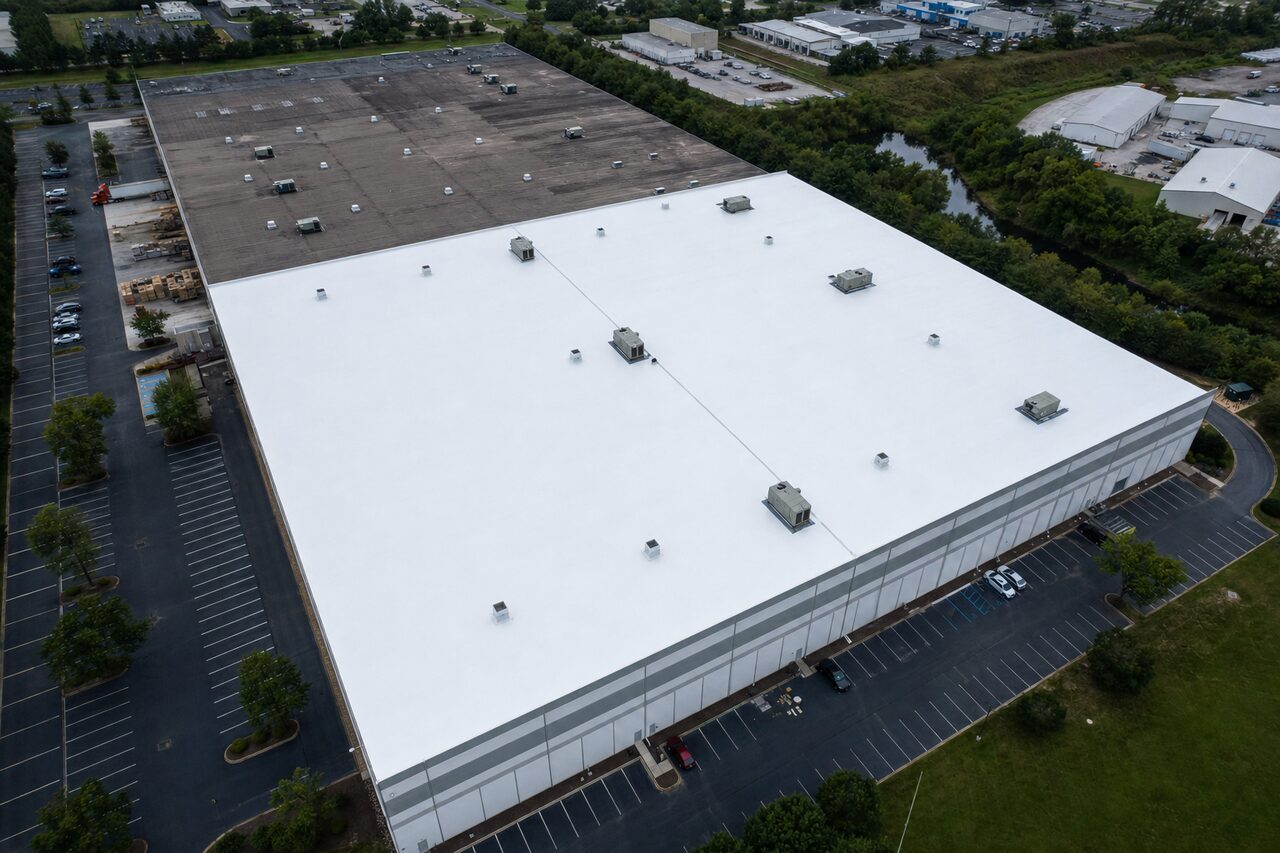
Industrial roof coating in South Dakota is how food-processing plants, distribution centers, and manufacturers across the hail belt stop leaks and add decades of waterproof life to an aging low-slope roof — without a tear-off and without shutting down production. Industrial Roof Coating Pros is the Gaco-certified silicone applicator serving Sioux Falls, Rapid City, and industrial buildings statewide.
A industrial roof coating in South Dakota has to survive the full violence of Northern Plains weather, and silicone is engineered for exactly that. South Dakota industrial roofs sit in the heart of the hail belt, where severe summer thunderstorms hammer membranes with hail and straight-line winds, then face brutal continental winters with deep cold, heavy snow load, and dozens of freeze-thaw cycles. The chinook winds along the Black Hills can swing temperatures dozens of degrees in a matter of hours. That combination of hail, wind, UV, and rapid thermal cycling is what tears seams, backs out fasteners, and opens leaks on the state’s big-footprint industrial roofs — and a seamless, flexible, ponding-resistant silicone membrane answers all of it at once.
Three properties make silicone the right system for South Dakota. It stays flexible through the area’s violent freeze-thaw swings, so it moves with the building instead of cracking. It is moisture-cured and ponding-resistant, which matters on the large, slow-draining flat roofs that cover the state’s food-processing plants and distribution centers. And it cures into one monolithic membrane with no seams or laps to fail — documented, warrantied restoration that stands up to the insurance scrutiny that follows every hailstorm in this part of the country.
Just as important, a silicone restoration avoids the tear-off entirely. In a climate where every open roof is a weather gamble — and on a building where the real cost of a roof project is the production it interrupts — coating over the existing membrane in a matter of days rather than demolishing and rebuilding over weeks is a meaningful reduction in risk on top of the cost savings. The line keeps running underneath while the roof gets watertight again.
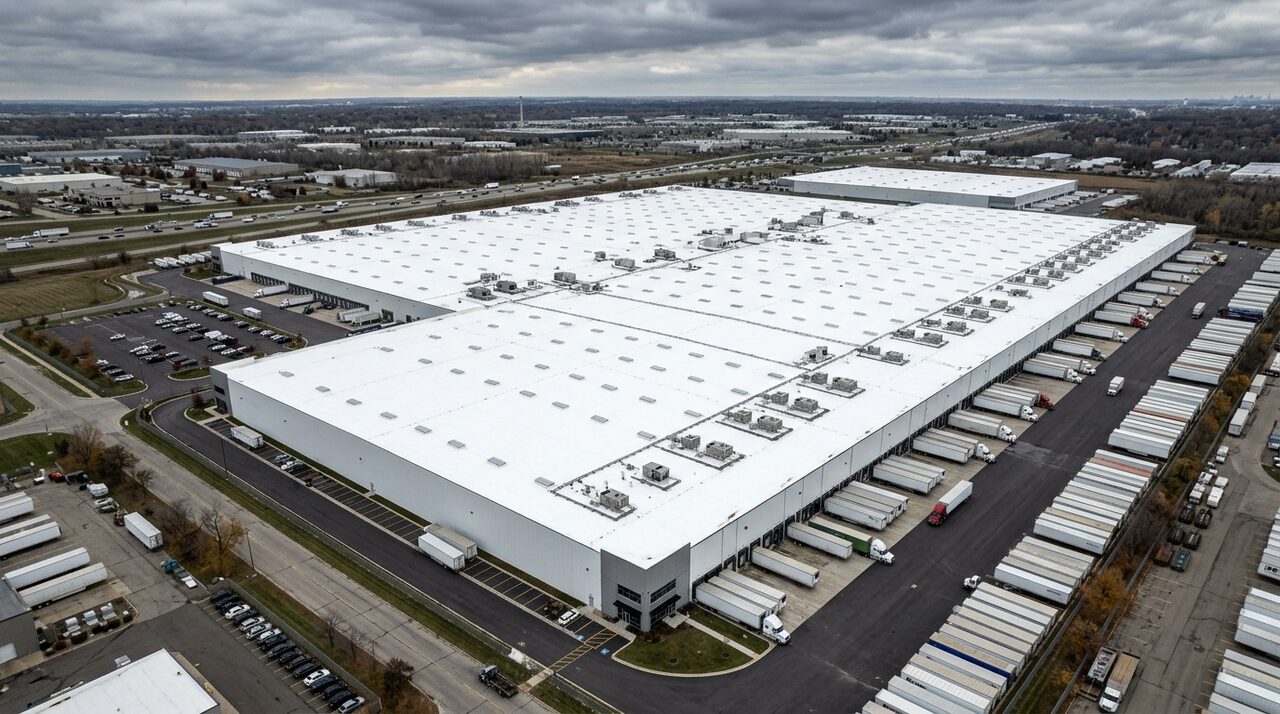
South Dakota’s industrial economy is anchored by food processing, meatpacking, and the distribution corridors along I-29 and I-90, and those buildings carry exactly the kind of large low-slope roofs where a coating restoration delivers the most value. Sioux Falls is the state’s industrial hub, home to massive food-processing and meatpacking complexes alongside fast-growing distribution and logistics centers. Rapid City anchors the west, serving the Black Hills region with manufacturing, ag-processing, and distribution facilities exposed to extreme high-plains weather. Across both, the roofs are big, flat, equipment-dense, and increasingly past their original membrane life.
We restore single-ply TPO and EPDM, modified bitumen and built-up, and metal roofs — across warehouses, manufacturing plants, distribution centers, food processing, and cold storage facilities throughout Sioux Falls and Rapid City.
Industrial Roof Coating Pros is built specifically for industrial restoration — we do not chase residential shingle work. We hold a Gaco Applicator License (#345800) for silicone restoration, making us the only manufacturer-certified silicone applicator in this market, plus an Elevate full-system license (#40016194) and a GenFlex license for EPDM, TPO, and modified bitumen. That certification keeps your manufacturer warranty valid and guarantees the system is installed to the exact specification its chemistry demands, on roofs that carry live process loads and heavy rooftop equipment. Every South Dakota project starts with a free, no-pressure assessment and a written scope, with production-uptime scheduling built in. Our core silicone coating system, flat roof restoration, and roof leak repair pages explain the work in detail.
Replacing a working South Dakota industrial roof means demolition, landfill disposal, weeks of weather exposure, and — the number that usually matters most — production downtime over a plant, a distribution floor, or a refrigerated facility. A silicone restoration typically costs a fraction of that, finishes fast, and keeps the building running. When the warranty winds down years later, a light recoat extends the roof again rather than starting the whole replacement cycle over. Our cost guide and coat-vs-replace page walk through the numbers, and a free assessment puts real figures on your roof.
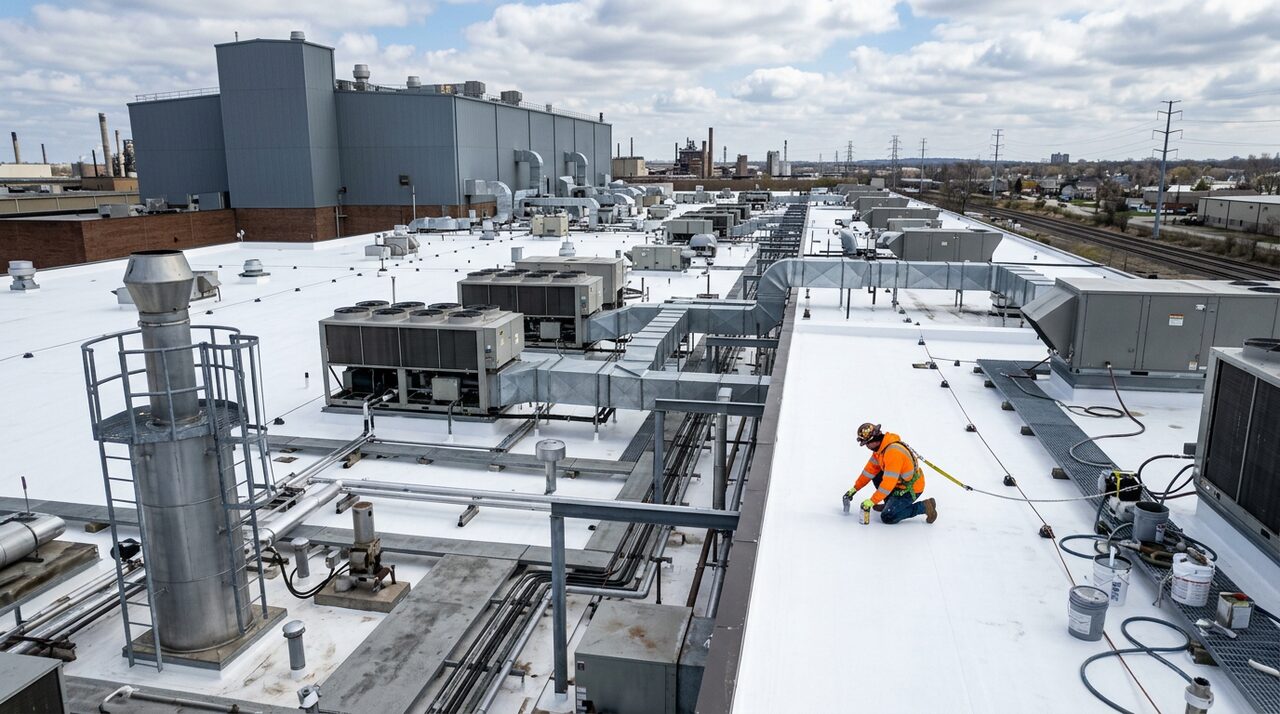
Find your city for local industrial roof coating and flat roof restoration. Don’t see yours? We travel statewide — and regionally for large bids — just request an assessment. See our Minnesota page for our other primary state.
Different industrial buildings fail in different ways — but the seamless silicone system that fixes them is the same proven chemistry, tuned to your substrate and your operations.
Acres of low-slope membrane over racking and inventory. A seamless silicone coating seals the whole field at once and reflects summer heat off the building.
See the system → 02 / ManufacturingDense rooftop equipment, process exhaust, and constant vibration punish flashings. We restore the roof around live operations with minimal downtime.
See the system → 03 / DistributionMassive single-roof footprints with tight throughput tolerances. A coating restoration keeps freight moving while the roof gets watertight again.
See the system →A roof coating is a chemistry product, and chemistry only performs when it is installed by a trained, manufacturer-certified applicator to the exact specification it was engineered for. That is the single biggest reason cut-rate coating jobs fail on industrial buildings: an uncertified crew applies the wrong millage, skips the prep, or uses an incompatible primer, and the warranty is worthless because the manufacturer never stood behind the installation in the first place. On an industrial roof carrying live process loads and heavy rooftop equipment, that gamble is not worth taking.
Industrial Roof Coating Pros is built to avoid exactly that. We hold a Gaco Applicator License (#345800) for silicone roof coating restoration — making us the only manufacturer-certified silicone applicator in this market. We also carry an Elevate (Holcim/Firestone) full-system license (#40016194) and a GenFlex license covering EPDM, TPO, and APP/SBS modified bitumen systems. That breadth means we can match the right system to your existing roof rather than forcing one product onto every job, whether you run a warehouse, a manufacturing plant, or a refrigerated food facility.
The practical payoff is a warranty you can actually rely on. Because a certified applicator installs the system to spec, the manufacturer backs it — and the silicone membrane can be recoated down the road to renew that warranty and extend the roof again. You are not just buying a coating; you are buying a documented, warrantied, renewable roofing program from a licensed and insured contractor that specializes in industrial work. Every project starts with a free, no-pressure assessment and a written scope, so you know precisely what the system includes before any work is scheduled. As a property of Sellers Roofing Company, we bring decades of regional commercial roofing depth to every industrial bid.
We keep the process transparent from the first contact to the final walkthrough, because an industrial roof coating is a multi-year commitment and your facilities and finance teams should know exactly what they are buying. Here is how a typical industrial project unfolds once you request a free assessment.
1. Free assessment and moisture survey. We schedule a roof walk around your operations and document everything — ponding areas, wet insulation flagged by infrared or core samples, failed seams, penetrations, and flashings — with photos. You get a written assessment, not a sales pitch, and an honest call on whether a coating is the right move for your roof.
2. Written scope and proposal. We put the recommendation on paper: the system we propose, the prep and repairs included, the warranty term, the per-square-foot pricing, and the production-uptime plan. There are no surprises buried in the fine print, and we are happy to walk your finance team through how the project is classified for capital versus maintenance.
3. Scheduling around production. Industrial buildings keep running during most coating projects. We coordinate crew access, staging, lift placement, and any rooftop equipment so your line, your clean rooms, and your loading docks are disrupted as little as possible — often not at all, with off-hours work where needed.
4. Prep, repair, and reinforcement. The roof is power-washed, failed areas are repaired, wet insulation is replaced, and the trouble spots — seams, fasteners, drains, curbs, process penetrations, and wall transitions — are reinforced with fabric-embedded silicone and detail coats before any field coating goes down.
5. Seamless field coat. The silicone is applied at the manufacturer-specified millage, curing into one continuous, reflective, ponding-resistant membrane across the entire roof field — with low-odor, fast-cure formulations available for occupied and food-grade environments.
6. Final walk and warranty. We walk the finished roof with you, confirm the details, and register the manufacturer warranty. Because we are certified, that warranty is valid — and it can be renewed years from now with a light recoat instead of a full replacement.
A properly prepped and applied silicone system carries a manufacturer warranty of up to 20 years, and because silicone is recoatable, a light refresh at the end of the term renews the warranty and extends the roof again. One sound deck can deliver decades of waterproof service from a single restoration program rather than repeated tear-offs.
Almost never. Because we coat over the existing roof rather than tearing it off, crews work above while your operations continue underneath. We coordinate staging, access, and any rooftop equipment around your shifts — including off-hours and weekend work for sensitive production or clean-room environments.
Yes — as long as the deck is sound and the insulation is mostly dry, a coating restoration seals leaks at their source. We confirm the roof qualifies with a free infrared or core moisture survey before recommending the work, and we cut out and replace wet insulation so we are not sealing in a problem.
A coating restoration typically runs roughly half the cost of a tear-off because you are not paying to demolish, dispose, and rebuild — and you avoid the production downtime that often dwarfs the roofing line item itself. The exact figure depends on roof size, condition, and complexity, which is why we price every industrial job from an on-roof assessment.
Certification means the manufacturer has trained and audited how we prep and apply the system, and it is what makes your warranty valid. As the only Gaco-certified silicone applicator in MN and SD, we install the system exactly as its chemistry was engineered for, on roofs that have to perform under industrial loads.
Tell us about your building anywhere in South Dakota. We’ll walk the roof, document its condition, and email you a straight coat-or-replace recommendation — with production-uptime scheduling built in.
We’ll reach out by email shortly to schedule your free industrial roof assessment.